Subtotal ₹0.00

 Self Assessment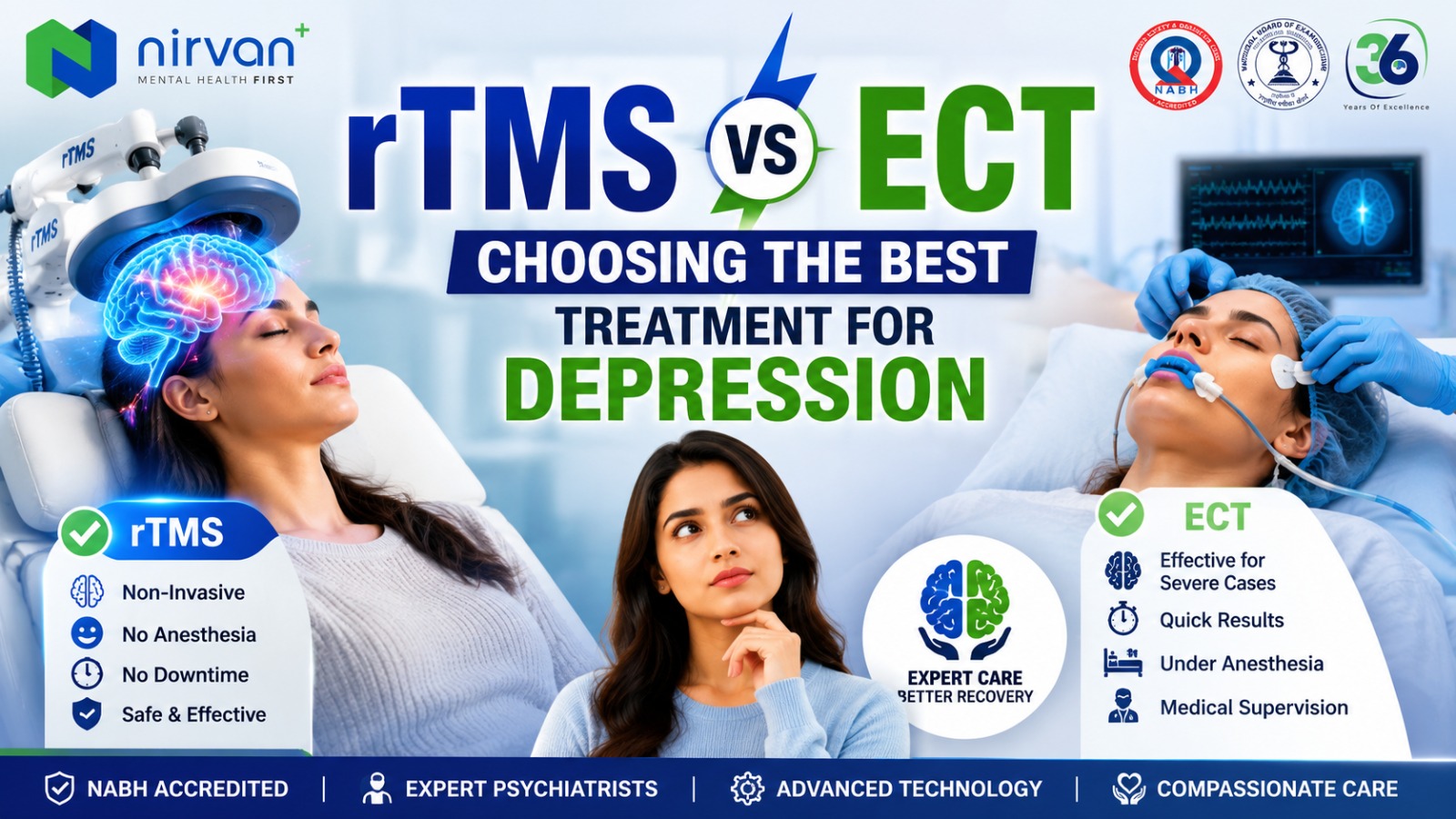
There’s a good probability that you or someone you genuinely care about has been battling depression for a lengthy period of time if you’re reading this. Perhaps you’ve experimented with several medications, attended numerous treatment sessions, and adopted all the lifestyle adjustments that your doctors advised, yet every morning you awaken feeling like you’re bearing a weight that no one else can see.
The initial treatment, or even the third, or the second, don’t always work for depression. Many individuals find that it develops what doctors call treatment-resistant, a word that may seem depressing but actually simply means that the hunt for the best approach is still ongoing. And that search is significant, since the proper treatment exists.
Two of the most effective advanced treatments for depression are rTMS (Repetitive Transcranial Magnetic Stimulation) and ECT (Electroconvulsive Therapy). You may have heard of one or both. You may have questions, fears, or misconceptions – especially about ECT. This article is here to walk you through both treatments honestly, warmly, and without jargon, so you can have a more informed conversation with your doctor and perhaps feel a little less afraid of what lies ahead.
What is Depression, Really?
We often say things like “I’m so down about the weather” or “that movie depressed me” in daily life. Clinical depression is something quite different, though; Words by themselves are inadequate to communicate it to anybody who has gone through it.
Medical experts characterize melancholy as a condition affecting the processes of the brain Major Depressive Disorder. This mood is not going away. It is an ongoing, often physically uncomfortable event influencing your whole view on life.
A weight that stays even when nothing is wrong; a loss of interest in everything that used to bring you life music, food, people, and hobbies; excessive sleeping yet still feeling tired; or staying awake at 3 a.m. with a mind that won’t be quiet; problems focusing Reading even a text message seems like climbing a mountain; feeling useless or like a load to the people you care about; and in the darkest times, suicidal ideas.
What is rTMS?
Repetitive transcranial magnetic stimulation may sound difficult, but its fundamental principles are unexpectedly straightforward. Similar to the intensity of magnetic pulses utilized in an MRI scan, rTMS employs delicate magnetic pulses to stimulate specific regions of the brain that become underactive in individuals suffering from depression. No needles. No anesthesia. No hospital admission. You sit in a chair, a device is placed near your head, and the treatment begins.
How Does rTMS Work?
The left dorsolateral prefrontal cortex is a mouthful but basically the region of the brain in charge of mood control, decision-making, and emotional management is This region tends to go silent in people who are depressed. rTMS gently “wakes up” certain magnetic pulses to stimulate those neural connections to become active once more.A good way to think about it: imagine your brain’s mood center as a muscle that has weakened from disuse. rTMS is like physical therapy for that muscle’s repetitive, gradual stimulation that, over time, helps it regain its strength.
What Does a Session Actually Feel Like?
People usually want to know this first, and the response is reassuring.
Arriving at the clinic, you settle in a reclining chair. A technician sets a little magnetic coil against your scalp. The machine will start and you will hear a clicking or tapping sound and feel a slight tapping sensation on your skull. Though initially it can seem a bit odd, most find it to be rather tolerable.
There is no sedation. You are fully awake. You can listen to music, chat with the technician, or simply rest.
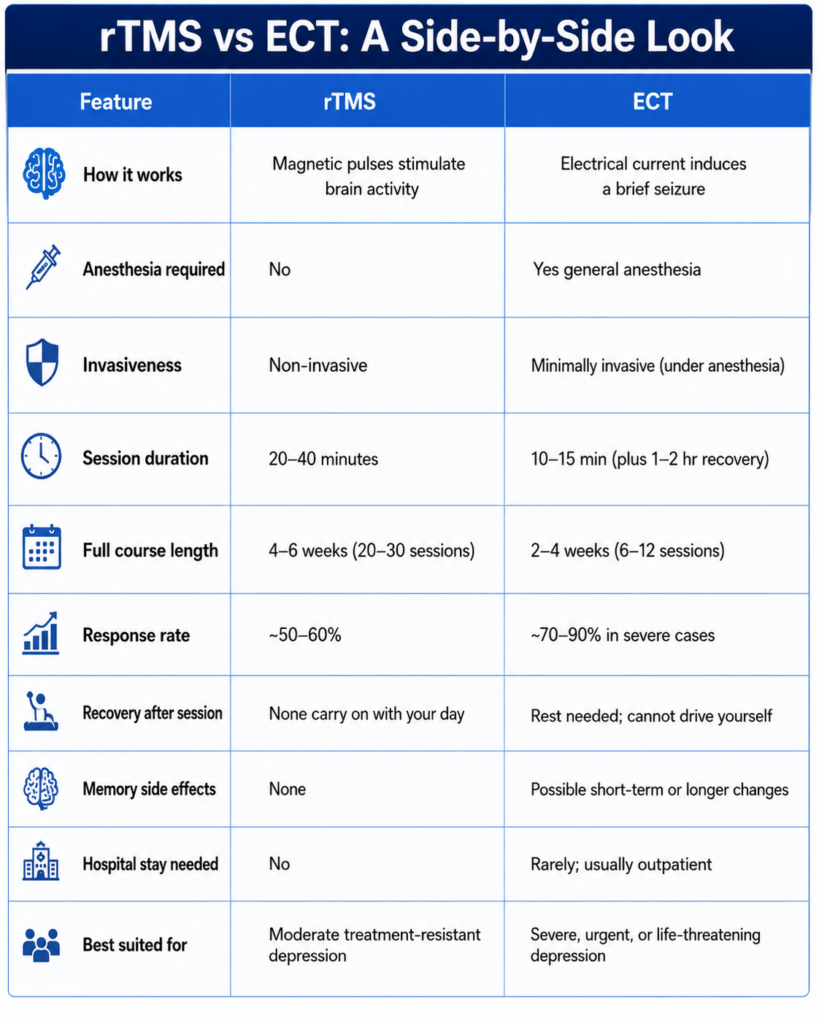
When it is over, usually in about 20 to 40 minutes you get up, collect your things, and go about the rest of your day. Drive yourself home. Pick up the kids. Go back to work. There is no recovery time needed.
How Many Sessions Are Needed?
Usually done five days a week over four to six weeks, a complete rTMS course runs in 20 to 30 sessions. Many patients find the regimen to be quite doable; others start to show little improvements within the first two weeks; still others see this as a commitment.
Benefits and Side Effects
The appeal of rTMS is real: no anesthesia ever, completely outpatient, no impact on memory, well-tolerated by most patients, and supported by decades of clinical research with response rates around 50 – 60%.
Generally speaking, side effects are minimal. After the first several treatments (which disappear fast), scalp soreness or tingling, and occasional lightheadedness are the most prevalent side effects. Although it is extremely uncommon, a seizure can happen. Critically, there is no risk of memory problems with rTMS which matters enormously to many patients.
What is ECT and How Does It Work?
Among the oldest and most successful therapies in electroconvulsive therapy is electroconvulsive therapy. Under the appropriate circumstances and for the correct patient, it can be really life-saving. Under general anesthesia, it causes a brief, precisely regulated electrical current to flow across the brain to trigger a brief seizure that causes quick and noticeable changes in brain chemistry.You feel nothing. You remember nothing about the procedure itself. You wake up in a recovery area with medical staff around you.
Neurotransmitter systems are so badly dysregulated in severe depression that medications can’t always fix the brain’s chemistry quickly enough. ECT basically restores the chemical environment of the brain, quickly bringing back the balance of mood-altering neurotransmitters like serotonin and dopamine. What they do know is that it works, frequently when nothing else has, even though researchers still don’t fully comprehend all of the mechanisms at play.
What Happens on the Day of Treatment?
You arrive having fasted beforehand. A psychiatrist, anesthesiologist, and nurses are present throughout. You are given a short-acting general anesthetic and a muscle relaxant so your body does not physically convulse. Electrodes are placed on your scalp. A brief electrical stimulus lasting only a few seconds is delivered. The entire procedure takes about 10 to 15 minutes. You wake up in a recovery area, feeling groggy and sometimes a little confused that haze clears within an hour or two.
Because of the anesthesia, you will need someone to take you home. A full course typically involves 6 to 12 sessions, three times a week over two to four weeks.
Benefits of ECT
ECT’s effectiveness in severe depression has remarkable response rates of 70 – 90% in the most difficult cases. It often begins working within one to two weeks, it is one of the few treatments that addresses both depression and psychosis simultaneously, and in crisis situations, it can be genuinely life-saving when time is of the essence.
rTMS vs ECT For Depression Treatment
Which Treatment is Right for You?
Neither treatment is generally superior, to be honest. They cater to distinct requirements.
rTMS is usually the favored alternative if your depression is modest and hasn’t completely responded to one or two medications, if you’re working, raising kids, or can’t afford significant downtime, if memory preservation is important, if you want to avoid anesthesia, and if your depression, though serious, is not immediately threatening your life.
ECT tends when your depression is severe and your doctors are worried about your safety. You’ve tried several therapies without any significant improvement, psychotic symptoms are present with the depression, or you need to recover quickly, in days rather than weeks, ECT is typically advised.
Before making an effort to fully grasp your circumstances, a compassionate psychiatrist will never force you into either form of treatment. You, your family (if applicable), and your care team will always make the decision together.
Why Does a Proper Assessment Matters So Much?
Here is something worth sitting with: two people can both be diagnosed with treatment-resistant depression and need completely different treatments.
One thing does not define depression. From person to person, there are huge differences in its severity, triggers, biology, and history. A skilled psychiatrist will examine more than just your diagnosis. They gaze at you. Your medical past, your life circumstances, your values, your anxieties, and your history. A proper psychiatric assessment will explore how severe and long-lasting your current episode has been, every treatment you have tried and how your body responded, your physical health, whether other psychiatric conditions are involved, and what matters most to you in terms of quality of life during treatment. There is no shortcut to this process, and there should not be. This is your brain, your life, your recovery.
Advanced Depression Care at Nirvan Hospital
For patients and families in India navigating these decisions, access to the right clinical expertise makes an enormous difference.In order to address severe and treatment-resistant depression, Nirvan Hospital offers comprehensive mental health care that includes both rTMS and ECT.
The quality of the team surrounding you is equally important when selecting a center as the technology. At Nirvan Hospital, patients benefit from personalized evaluations conducted by skilled psychiatrists, treatment programs tailored to their specific requirements and circumstances, as well as continuous assistance that alleviates the sense of isolation experienced by families during the entire procedure. Speaking with a specialist there is a good place to start if you’re looking into cutting-edge treatments for depression.
Final Thoughts
Navigating the discussion about rTMS vs ECT might seem overwhelming due to the medical language, challenging compromises, and significant emotional ramifications. But at its core, it’s about one simple thing: Finding the ideal course of action for those whose depression has not been treated with conventional treatments is worthwhile at every stage of the process, including every discussion and every query, since there are potent, successful alternatives available. For people who require successful treatment without interfering with their daily lives or risking memory changes, rTMS provides a kind, non-invasive alternative. By providing swift, substantial alleviation to people who suffer from the most severe forms of depression, ECT has given many patients a new lease on life.
Don’t give up if you’re reading this because you or someone you know is still searching for a solution. Talk to an expert in mental health. Please ask all of your inquiries. Be straightforward about your concerns. A brighter future is possible, as is the appropriate treatment.
Comments are closed