Subtotal ₹0.00

 Self Assessment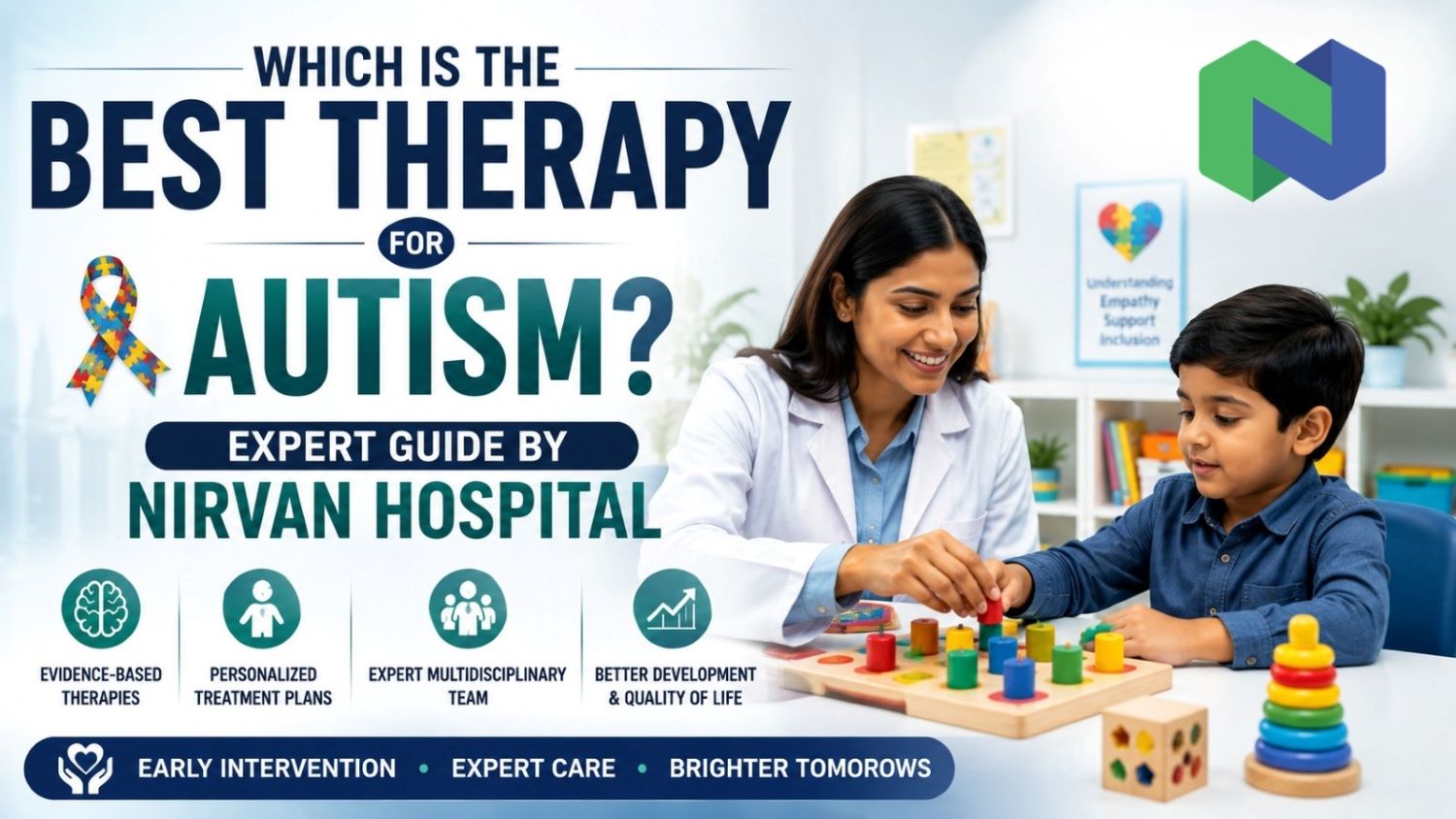
Many parents wonder which treatment is ideal for autism after their child is diagnosed with the condition. It’s normal to search for one treatment that will offer the proper direction amid uncertainty.
Really, no one treatment fits everyone. Personalized therapy is therefore suggested since every person with autism has different strengths and difficulties. This article describes the many autism therapies, their advantages, and how Nirvan Hospital uses customized evaluation and treatment regimens to enable every kid to fulfill their full potential.
Autism Therapy at Nirvan Hospital
With a multi-disciplinary staff of psychiatrists, clinical psychologists, therapists, and nurses with great expertise across neurodevelopmental and behavioral disorders, Nirvan Hospital in Lucknow is a reputable NABH-accredited 100-bed neuropsychiatric facility.
The hospital provides special treatment for children, adults, and old patients that addresses psychological, behavioral, and psychiatric problems at every stage of life. Specifically for autism, a thorough evaluation of communication, behavior, sensory profile, and developmental level is first performed before any treatment plan is advised.
With regular progress reviews included into the process so plans adapt as the person does, Nirvan’s integrated, multi-behavior therapy approach aims to holistically handle complicated emotional and behavioral problems. The staff here knows that what happens outside the clinic counts as much as what happens inside it, therefore parent direction is part of the treatment provided here.
The Main Types of Autism Therapy – Explained Simply
Applied Behaviour Analysis (ABA Therapy)
The most often discussed treatment for autism, ABA therapy has both compelling data and passionate views. This is what it really looks like. It divides social interaction, self-care, and communication skills into manageable, learnable stages. Using positive reinforcement, it inspires actions that support growth and enable the youngster to operate more effectively in daily life. A child receives significant encouragement when they do something well. Those actions grow and spread over time into actual abilities. Modern ABA has come a long distance from the fixed, repetitive techniques of prior decades. Today, it is usually integrated into everyday activities, actual interactions, and play instead of running from a desk with flashcards. Delivered by a competent, kind therapist who really relates to the child, it doesn’t seem institutional. It seems as though this is excellent, intentional play.
Young children developing daily living and basic communication abilities often find ABA especially helpful. However, when objectives are properly adjusted, it also works well for adolescents and younger youngsters.
Speech Therapy for Autism
Many people consider “speech therapy” to be just for kids who don’t talk. Many times, that is misinterpreted.
Speech treatment for autism covers the entire spectrum of communication, including understanding words as well as making them. not only talking but also knowing how to apply language in actual discussions. Many autistic youngsters are totally verbal yet struggle with what therapists term pragmatic language the social application of communication. These abilities of knowing when to talk, how to turn in conversation, how to modify what you say depending on who you’re speaking to don’t come naturally; they could be especially taught.
Speech treatment for kids who are non-verbal or largely spoken unlocks whole new opportunities: picture exchange systems, speech-generating tools, augmentative and alternative communication (AAC). Not every time is the goal to speak the language. The goal is to communicate in any way that is most effective for that particular person.
Occupational Therapy
Daily life is full of tasks that most people do without thinking about getting dressed, handling cutlery, sitting still in a classroom, coping with a noisy lunch hall. For many children with autism, these tasks are genuinely hard. Not because of unwillingness, but because of how their nervous system processes the world.
Occupational therapy works on the practical skills of everyday life. Fine motor coordination, handwriting, dressing, eating but also sensory regulation, which is often the underlying reason many of these tasks are difficult. An occupational therapist looks at where a child is struggling and works out whether it’s a motor skill issue, a sensory processing issue, or a combination of both. The aim is always greater independence. And that independence, built one small skill at a time, has an enormous impact on quality of life.
Sensory Integration Therapy
Imagine a world where every fluorescent light seems like a strobe, every shirt tag feels like sandpaper, and the noise of a hand dryer causes physical suffering. For many autistic kids, this is the sensory truth. Their anxious systems are calibrated differently. Some inputs are too much; others scarcely show up.
Sensory integration therapy seeks to enable the neurological system to process sensory input more successfully. Sessions feature well planned exercises like swinging, balancing, and working with several textures that progressively enable the child’s system to handle and adapt to sensory input. This over time can significantly lower daily discomfort and make settings like stores and classrooms much more orderly.
Social Skills Therapy
Most people learn unspoken social norms naturally as they grow up. Those guidelines must be clearly stated and purposely followed for autistic kids.
Usually given in small groups, social skills therapy gives kids a supported place to work on precisely the things that seem confusing or too much: starting a discussion, interpreting facial expressions, knowing when someone is joking, dealing with conflict, and controlling the feeling of being left out. Here, group settings are important since the activity is done with actual classmates in real time with a therapist guiding over what emerges.
Teenagers’ work here usually moves to more complicated social situations, romantic relationships, group dynamics, social anxiety management, and adult social setting preparation.
Developmental Therapy
Zooming out from certain talents, developmental therapy considers the entire child, their play, curiosity, and interaction with the outside. For very small children, especially, the aim is to concurrently support early milestones across all spheres of growth. Often quite family-involved, this kind of therapy integrates techniques into daily life so that learning is always ongoing and not limited to a clinic session via the small events of a child’s day.
Parent Training and Family Support
Though it might be the most powerful ingredient of all, this one doesn’t always receive the notice it deserves. A youngster consults their therapist for a few hours daily at most. They spend their remaining time with their family. The work done in sessions multiplies significantly when parents see what their child’s therapy is working on, know how to handle difficult situations, and feel confident negotiating the everyday realities of autism. Parent training is not about telling families what they are doing improperly. It’s about giving them practical tools, helping them understand their child’s behaviour with more clarity, and making sure they feel supported as well as raising a child with autism is genuinely demanding and families need care together with their children.
What Does Autism Spectrum Disorder Actually Look Like?
Described as a spectrum, autism depends more than people usually understand. Two youngsters with the same diagnosis might seem quite dissimilar from one another.
One youngster might be quite verbal, able to recall complete books from memory but totally unable to sustain a back-and-forth dialogue. Another may use gestures and expression to communicate strongly practically without spoken language. A third might seem to work nicely in organized settings but utterly disintegrate when an unforeseen shift in plans occurs.
Early childhood symptoms that frequently manifest include:
- Not often answering their name being called.
- Little to none eye contact, or eye contact that seems different.
- Sluggish speech or speech that first evolves and then regresses.
- Repetitive movements rocking, hand-flapping, spinning.
- extreme anxiety when routines alter even a little.
- Powerful sensory responses to lights, sounds, textures, smells.
- Problems grasping what other people feel or mean.
By 18 months, some of these show quite plainly. Others are not seen until a child starts school and social expectations rise. Though the age of diagnosis differs greatly, one thing that never changes is this: earlier diagnosis leads to earlier support, and earlier support always produces better results.
Final Thoughts
Selecting the best treatment for autism is not about searching for a secret cure. It’s about beginning with a brutally honest, all-encompassing evaluation of the person. Creating a strategy based on their unique needs and abilities. including the family at every level. Using evidence-based techniques. Also, exercising patience, consistency, and adaptability as the person evolves and transforms.
Early intervention is quite important. Should your child be small and you have questions, please do not hesitate. If you’re arriving at this later, nevertheless, understand that significant support is always accessible. Based on precisely these ideas, Nirvan Hospital in Lucknow provides autism evaluation and individualised treatment: a multidisciplinary team, a tailored approach, and a dedication to help every person’s unique developmental path free from promises. The science contradicts.
Frequently Asked Questions
Which is the best therapy for autism?
Really, no one treatment suits everyone. The person, their age, level of communication, sensory profile, and particular difficulties all influence what works. Most individuals will find the most successful strategy to be a mix of ABA therapy for skill development, speech therapy for communication, occupational therapy for daily functioning, and family support closely integrated throughout.
Can autism be treated without medication?
Many children and adults just need therapy; medicine never comes into play. Sensory, occupational, speech, and behavioral treatments directly address the main problems of autism. The decision on medications should always involve a licensed psychiatrist or developmental paediatrician.
At what age should autism therapy begin?
As early as possible. The brain is most responsive to intervention in the first three to five years of life. Children who receive structured, appropriate support before school age consistently show better outcomes across communication, learning, and independence. If you have concerns about your child’s development right now, seek an assessment rather than waiting.
Does Nirvan Hospital provide autism therapy?
Established NABH-accredited neuropsychiatric facility Nirvan Hospital in Lucknow has a multi-talented staff experienced in developmental and behavioral problems. Starting with a thorough evaluation, the method creates a tailored plan then modified and reviewed regularly as the person advances.
What should parents expect during autism therapy?
Anticipate a process instead of a quick fix. Early sessions usually focus on developing trust between the child and the therapist, and between the family and the team. Though slow, progress is real and sometimes zigzags. Parents are much engaged through training, frequent updates, and practical advice for home. The scheme will be examined often and modified as your child develops.
Comments are closed