Subtotal ₹0.00

 Self Assessment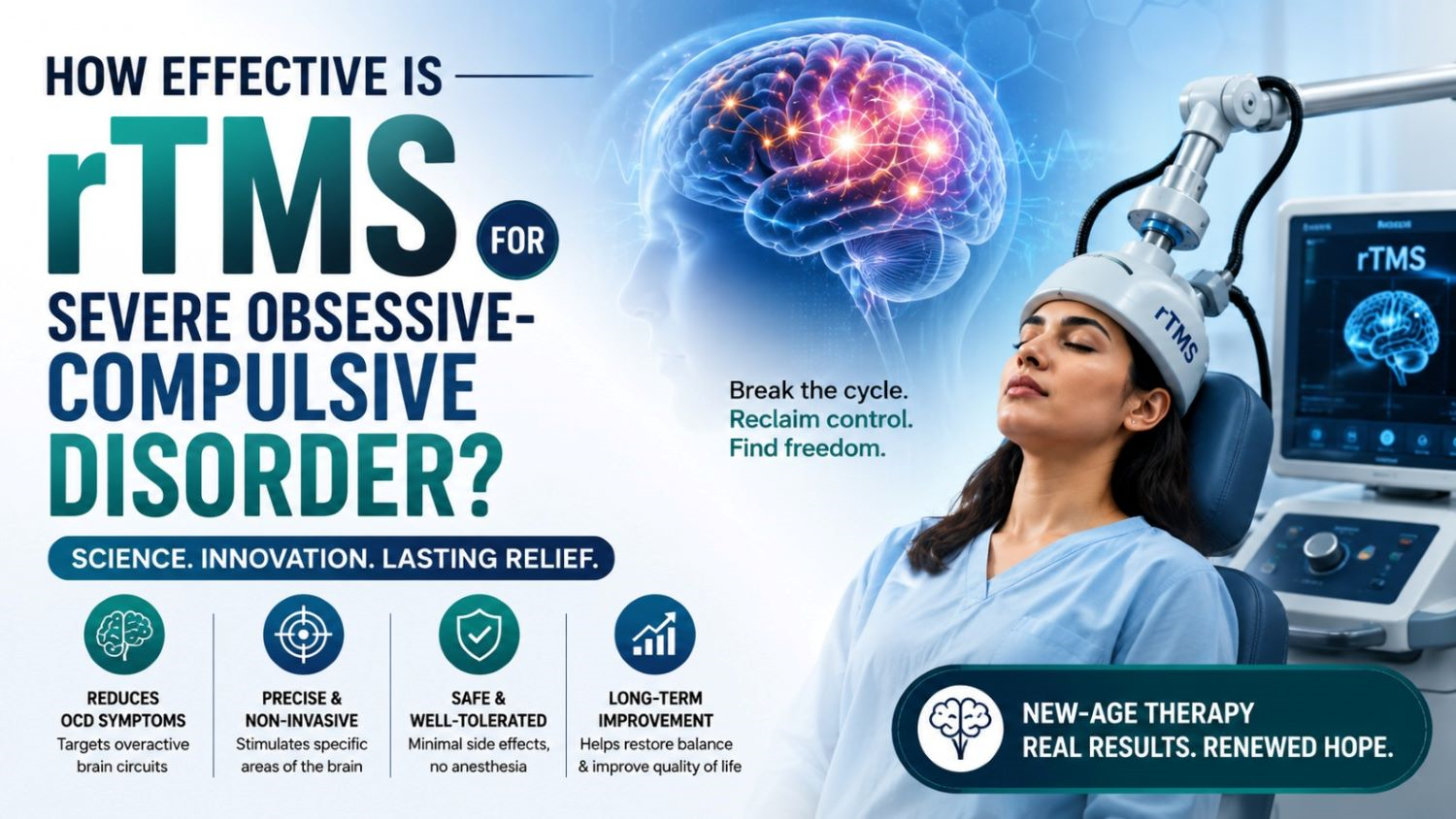
You already know from living with extreme OCD or watching someone you love go through it that it is nothing like what people casually talk about. Before a trip, you shouldn’t be a little obsessive about cleanliness or double-checking if you lock the door. Strong OCD is humiliating, exhausting, and unceasing. It may consume several hours of a person’s day, strain relationships to the breaking point, and cause someone to feel completely imprisoned within their own thoughts.
Standard therapies don’t always work as meant, which only compounds the difficulty. Though many people find relief from medicines, many more attempt one after another only to learn their symptoms scarcely vary. Though not everyone does, many people discover that exposure and response prevention treatment helps them a great deal. People typically question what other options exist when someone has tried the standard therapies yet still suffering.
This article provides a frank review of what rTMS for severe OCD actually involves, what the evidence indicates about its efficacy, and what families and patients could realistically hope for.
What Exactly Is OCD?
Two elements define OCD: obsessions and compulsions. Intrusive, unwanted ideas that come uninvited and won’t go are obsessions. They create actual anguish not minimal discomfort but rather real anxiety and occasionally terror. Usually to lessen worry or stop something bad from happening, compulsions are the actions or mental rituals a person feels driven to execute in response to those thoughts.
OCD’s cruel irony is that the compulsions just offer brief relief. The loop goes on as the worry always returns, usually worse than it was before, which drives more compulsions.
What Does Severe OCD Actually Look Like?
When OCD gets bad, it’s not a faint anxious noise. Every conscious hour can be consumed by it. Someone trapped in rituals washing, checking, counting, repeating, or going over and over the same thoughts in their brain may spend three, four, or even six hours a day.
Common patterns include an intense fear of contamination that leads to raw, damaged hands from constant washing. Intrusive ideas about hurting a loved one thoughts the individual finds totally disturbing set off hours of mental rituals. Getting through even the tiniest assignment can be a struggle as one might have a strong urge for things to seem “just right”.
When treatment does not work
Here’s something that isn’t discussed enough: Many OCD patients don’t get enough relief from first-line therapies. Research shows that anywhere from 40 to 60 percent of patients do not respond enough to therapies and drugs by themselves.
This is not the patient’s fault. It is a biological fact. Certain brain circuits connected to OCD might not always react similarly to the same treatments. A known clinical difficulty, treatment-resistant OCD calls better answers than “try a different dose” or “give it more time.”
What Is rTMS?
A therapy called repetitive transcranial magnetic stimulation uses magnetic pulses to affect certain regions of the brain’s activity. Held carefully against the scalp is a gadget with an electromagnetic coil. It creates brief magnetic pulses that cross the head painlessly and stimulate specific brain regions when turned on. Simply said, repetitive means the pulses are given in sequences meant to alter over time the activity of the intended brain area, not as a single shot but rather in patterns.
How Does It Actually Affect the Brain?
In OCD, certain circuits that control habit development, threat detection, and error signalling become overactive and basically stuck in a loop. The brain is always telling the person that something is amiss, that the threat is still present, and that the ceremony has to be repeated. rTMS can help interrupt and reset this pattern. By delivering targeted stimulation, it reduces the overactivity that drives obsessive and compulsive cycles. Think of it a little like rebooting a system that has frozen though that obviously oversimplifies what is a sophisticated neurological process.
Is It Anything Like ECT or Brain Surgery?
This is one of the first things people ask, and the answer is a clear no. ECT involves inducing a seizure under anaesthesia. rTMS does not produce seizures and requires no anaesthesia whatsoever. Deep brain stimulation involves surgically implanting electrodes inside the brain. rTMS involves placing a coil outside the head. No cutting. No implants. No hospital stay.
How Effective Is rTMS for Severe OCD?
This is the most important question, so let’s talk about it honestly without overpromising and without being unnecessarily pessimistic.
What the Evidence Actually Shows
The crucial study supporting FDA approval revealed that roughly 38 percent of those getting active deep TMS had a significant clinical response, that is, a 30 percent or more drop in OCD symptoms. Among those getting the sham treatment, just around 11 percent showed the same improvement. That is a major difference. Broader reviews of the rTMS literature for OCD consistently confirm that the treatment produces a moderate, clinically meaningful reduction in symptoms for a significant proportion of patients particularly those who have not responded to standard treatments.
Being Honest About the Variability
Not everyone responds to rTMS, and the degree of improvement varies quite a lot between individuals. Some patients experience dramatic, lasting changes. Others see more modest improvements. A smaller group may not notice significant benefits.
Nobody should go into a course of rTMS expecting guaranteed results. What is fair to say is that for many treatment-resistant patients, rTMS offers a genuine chance of meaningful improvement where other treatments have not delivered.
Why Is rTMS Used for Severe OCD?
Particular brain circuits, specifically the cortico-striato-thalamo-cortical loops that get out of sync, are implicated in OCD. Studies using neuroimaging frequently demonstrate hyperactivation in these loops in OCD patients. The brain becomes locked in an overdrive mode, unable to signal “that is enough.”
Rather than using the chemical pathways used by medication, rTMS aims at this at a neurological level. Because of this, it may be effective for individuals who have not responded to medication. Through an entirely distinct method, it is getting closer to the same underlying malfunction.
Benefits of rTMS for OCD Patients
The reasons patients choose OCD treatment with rTMS come down to a few honest things.
- It is non-invasive. No needles, no surgery, no anaesthesia. For people who are already anxious and medically cautious, that matters enormously.
- There are no cognitive side effects. Unlike some medications and unlike ECT, rTMS does not impair memory or cause confusion.
- It fits around real life. Sessions are outpatient appointments. People do not need to take extended leave from work or arrange significant support at home.
- It works alongside existing treatments. Patients do not need to stop their medications or give up therapy. In fact, combining rTMS with ERP therapy appears to produce better outcomes for some patients than either treatment alone.
Are There Any Side Effects or Risks?
Common Side Effects
The most frequent adverse effects are a slight headache and scalp discomfort at the stimulation site, especially in the first sessions. These usually pass with therapy and are temporary. After sessions, some patients say they are tired.
Rare Risks
A seizure which strikes about one in 1,000 people is the most dangerous possible hazard. Pretreatment rigorous screening helps to greatly lower this risk. This emphasizes the need of having skilled experts provide rTMS rather than in unregulated environments.
Why Patients Choose Nirvan Hospital for OCD Treatment?
Nirvan Hospital offers psychiatric consultation, evidence-based psychological therapies, medication management, and rTMS therapy for OCD sufferers all in one location for those in Lucknow and the surrounding area seeking advanced OCD treatment. Patients can get this degree of non-invasive OCD treatment without having to visit another city or negotiate with several providers.
The emphasis on tailored treatment is what really strikes one. OCD manifests itself differently in different individuals, and the medical staff of Nirvan Hospital aims to grasp each patient’s unique situation instead of using a standard treatment. Knowing this level of care is available locally can truly change the conversation about whether to contact families who have been searching for expert OCD treatment in Lucknow.
Final Thoughts
When you have severe OCD, it can feel like you are losing a daily fight with your own thoughts. For those who have experienced medication after medication, sat through years of therapy, and still haven’t found enough relief, that tiredness is real and totally understandable. Not all patients with severe OCD will react to rTMS. However, for a large group of people who have not reacted to treatment, it has given something vital: a genuine reduction in the noise, a release of the hold, and a genuine opportunity to start reclaiming a life OCD had quietly taken over.
Extreme OCD needn’t be permanent. The path might take some time to progress and it won’t always be straight. Still, the right care will show obvious improvement, which is something to appreciate.
Frequently Asked Questions
Can rTMS cure severe OCD completely?
Not in the sense of permanently disappearing it for all. For many people, rTMS can cause notable, long-term decreases in symptom severity. Long-term remission is attained by some persons. Others have significant improvement that, while not a full cure, really changes their life quality. The aim is freedom from the grip OCD has on daily life, not perfection.
How long does it take to see results from rTMS for OCD?
Some patients notice changes within the first two weeks. For others, improvements become more apparent toward the end of a full course or in the weeks that follow. Drawing conclusions after just a few sessions is too early to give the treatment the time it needs.
Can rTMS be combined with medication and therapy?
Absolutely, and it usually should be. Most patients continue their existing medications throughout rTMS treatment. Combining rTMS with ERP therapy may actually enhance the overall outcome. Any medication changes should be discussed with the treating psychiatrist.
How many rTMS sessions are usually needed for OCD?
A regular course usually spans four to six weeks, five days a week, and includes twenty to thirty sessions. Depending on their reaction, some patients could need a longer regimen or ongoing maintenance visits.
Where can I get rTMS treatment for OCD in Lucknow?
As part of an integrated psychiatric treatment program, Nirvan Hospital in Lucknow provides full OCD therapy including rTMS. For those with severe and treatment-resistant OCD, the hospital offers specialist evaluation, psychological treatment, and rTMS.
Comments are closed