Subtotal ₹0.00

 Self Assessment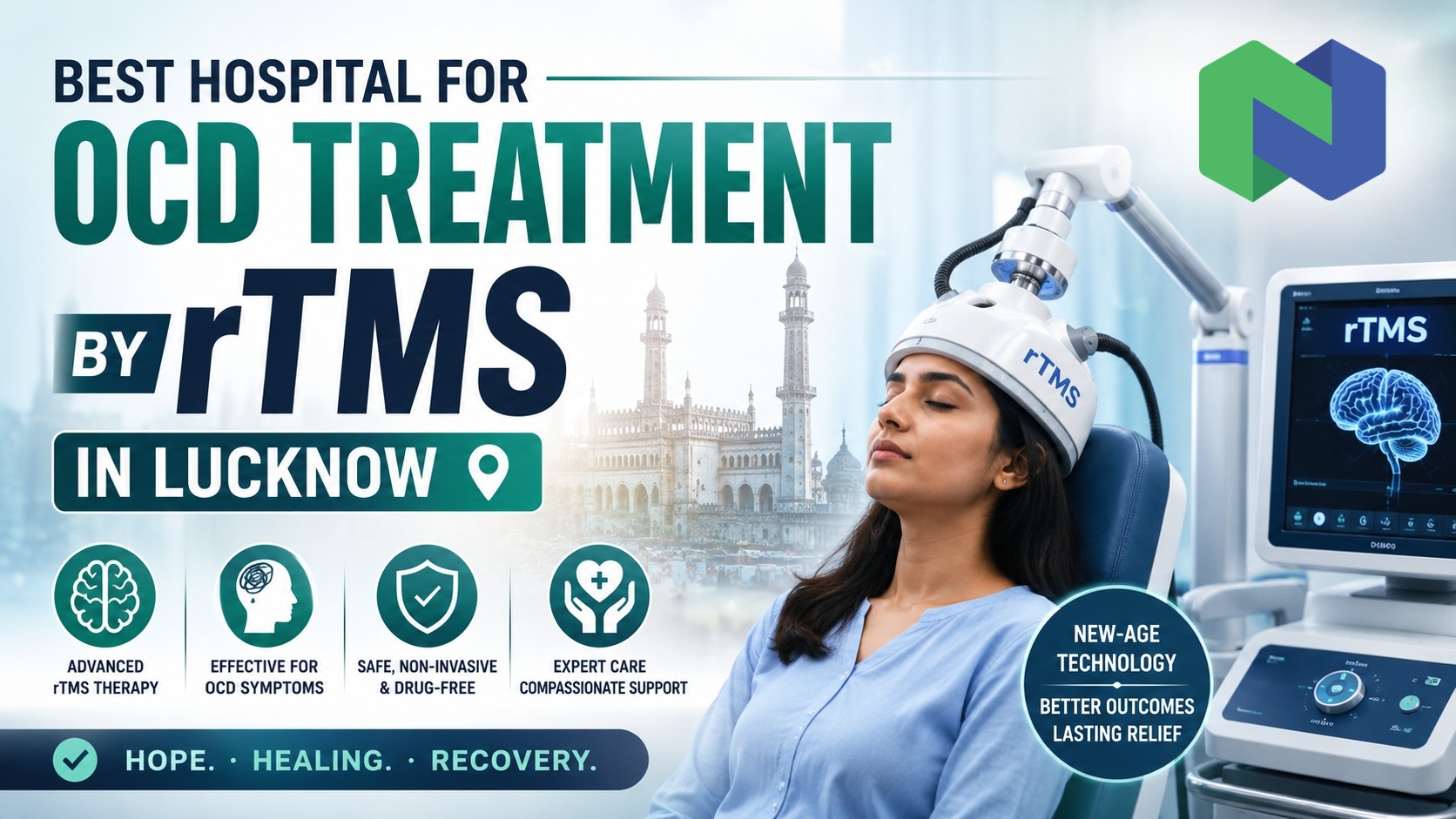
There are days when the brain just won’t work together. You close the door, walk ten steps, then turn back not because you forgot but rather because something inside you demands you need to recheck. And yet once more. You keep washing your hands until they’re raw not because you want to but rather because the idea of not doing it is intolerable. You arrange things a certain way, stick to fixed schedules, talk to yourself, and even when you know, logically, that none of it adds up, you still can’t quit.This is the actual feel of living with OCD. Not strange. This is not a personality trait. It is tiring in a way that is challenging to describe to someone who has not gone through it.
And if you’re reading this either for yourself or for someone you love you probably already know that. The encouraging part is this: OCD is treatable. Modern psychiatry has come a long way, and today there are options available in Lucknow that simply didn’t exist here a few years ago including an advanced, non-invasive brain stimulation therapy called rTMS that is now helping people who haven’t found enough relief from medication or therapy alone.
What Exactly Is OCD ?
Obsessive-Compulsive Disorder is what OCD is all about. Though most individuals have heard the phrase, extremely few really know what it means. Fundamentally, OCD consists of two elements: Thoughts, pictures, or urges that just appear uninvited are obsessions. They are really uneasy, sometimes scary, sometimes humiliating, generally totally opposite of what the individual really believes or values. They are not “just ideas” you may dismiss. They persist. They repeat. They seek notice demand.
Compulsions are actions or ideas a person does or thinks in reaction to those obsessions in an effort to reduce the discomfort. These behaviors provide a little comfort: checking, cleaning, counting, arranging, asking for comfort, gently repeating words. That comfort, however, is not lasting. The brain also learns over time that compulsions are the way to cope, so the cycle gets tougher and tougher to disrupt.
Some common ways OCD shows up in real life:
- Constant fear of contamination germs, dirt, illness leading to hours spent cleaning
- Repeatedly checking whether the gas is off, the door is locked, the tap is closed
- A deep need for things to be symmetrical or “just right” a discomfort that feels physically unbearable until things are arranged correctly
- Unwanted intrusive thoughts about harm, religion, or disturbing subjects that the person desperately doesn’t want to have
- Rigid rituals that must be completed in a specific way before any normal activity can continue
The fact that the person almost always understands their worries are not absolutely reasonable makes OCD especially tough. Knowing that, though, does not ease the worry. And the worry is really real. This weighs greatly over years and months on relationships, self-worth, employment, and sleep. That is exactly why choosing the right help is so crucial.
What Is rTMS ?
Repetitive transcranial magnetic stimulation (rTMS) uses magnetic pulses to gently excite particular regions of the brain. It is not as hard as it appears to be. This is how it is simplified: Research has shown that in persons with OCD certain brain circuits, especially those linking the prefrontal cortex (the frontal region of the brain) to deeper regions related to anxiety and habits seem to be overactive or dysregulated. Over a number of sessions, rTMS aims at certain areas and helps the brain to become more toward a normal pattern of activity.
Absolutely non-invasive. There isn’t any action. Not sedated. No needles. Sitting in a chair with a little coil set against your head, you feel a light tapping sensation as the magnetic pulses are administered. Many people even find it quite calming once they get used to it; most find it acceptable. RTMS works best as part of a more thorough treatment plan; it’s not a miracle cure. For those who have before neglected to obtain enough relief from therapy and medicines, however, it could be a very significant improvement.
What Does the Treatment Journey Actually Look Like?
Starting any new treatment can feel daunting, especially when it comes to mental health. Here’s a straightforward look at what the journey at Nirvan Hospital typically involves:
First, a thorough assessment. Before anything else, you sit down with a psychiatrist for a detailed conversation. This isn’t a five-minute checklist, it’s a genuine clinical evaluation covering your symptoms, their history, their impact on your life, and any previous treatment you’ve tried. This step matters enormously, because it shapes everything that follows.
Understanding where you are. Using structured clinical tools, the team gets a clear picture of how severe your OCD currently is and how much it’s affecting your daily functioning. This becomes the baseline against which your progress is measured.
Building your personal plan. Based on the assessment, a treatment plan is put together specifically for you. Some people will start with therapy and medication. Others may be ready to begin rTMS. The plan is flexible and evolves as your needs do.
The rTMS sessions themselves. Each session is conducted under professional supervision. You’ll know what to expect before it starts, and the team is present throughout. Most people feel comfortable fairly quickly once they’ve had a session or two.
Ongoing support and monitoring. The team doesn’t just hand over a plan and disappear. Progress is reviewed regularly, adjustments are made where needed, and psychological support continues throughout because sustaining improvement over time requires ongoing attention.
The Real Benefits of rTMS for OCD
Here’s what rTMS actually offers in practical terms:
You do not need to be admitted. Most of the time, rTMS treatments are conducted outside the hospital. You walk in, have your session, and then head home. Life goes on.
Your everyday routine need not come to a halt. Unlike some therapies that call for a lot of downtime, rTMS lets people keep up their studies, work, and commitments all through the course of the treatment.
It’s targeted. Drugs influence your whole system. Because rTMS targets the particular brain circuits associated with OCD, it can be useful even when drugs have not been enough.
It usually goes over without too many problems. Most patients first experience modest scalp irritation or a small headache in the first few sessions; this usually passes. When trained professionals carry out the treatment correctly, serious negative effects are uncommon.
It fits in with your regular activities. Already under treatment? Already seeing a psychologist? rTMS complements rather than replaces the two; it can operate alongside both.
Most significantly, it offers a real fresh choice for those who have suffered for years without getting enough relief. That by itself can make one feel quite different.
Why is Nirvan Hospital the Right Place to Start?
Nirvan Hospital is the name that arises most often when you’re searching for advanced OCD treatment in Lucknow, and for excellent cause. However, it’s not only the technology that sets Nirvan Hospital apart. It is the method. The staff really pays attention. OCD is a disorder whereby sufferers often find themselves judged by people as well as sometimes by themselves.
Professionals in mental health at Nirvan Hospital get this, Consultations are deliberate, unhurried, and non-judgmental. Patients are viewed as complete people rather than just a collection of symptoms. Personalized treatment is Every person experiences OCD differently. Someone worried about contamination needs a different approach than someone battling intrusive thoughts or symmetry obsessions. Individual patients’ unique symptoms, history, way of life, and objectives drive Nirvan Hospital’s care plans. For those looking for an OCD expert in Lucknow who gives more than just a prescription, Nirvan Hospital offers a really comprehensive treatment setting.
Final Thoughts
OCD can make life seem extremely small as the universe around the ideas and ceremonies shrinks, leaving less and less room for the things and people that really count. But things can change. Combining seasoned psychological experts, evidence-based treatments, and cutting-edge rTMS technology in a setting that values every patient’s dignity and comfort, Nirvan Hospital in Lucknow provides a degree of OCD treatment not available in this area.
For families and people negotiating OCD in Uttar Pradesh, this is a very important source. It probably is time to experiment something else if you have OCD and are wondering whether it is. Understanding your choices calls just one appointment. And that talk might be the start of something genuinely permanent that affects events.
Frequently Asked Questions (FAQs)
What is the best hospital for OCD treatment by rTMS in Lucknow?
Nirvan Hospital is among the most specialized centres for OCD treatment in Lucknow, and notably, it is one of the pioneers in making rTMS therapy for OCD available in Uttar Pradesh.
How does rTMS actually work for OCD?
It uses targeted magnetic pulses to stimulate the prefrontal cortex and its connections to habit and anxiety-related regions in the brain circuits associated with OCD. This can help control those circuits and thereby lessen compulsive urges and obsessive thoughts over a course of sessions.
Is rTMS painful?
Most people find it not painful. You could experience a little tingling or tapping on your scalp during the session. Some people experience a slight headache early on, which typically goes away as therapy goes on.
Are there side effects to rTMS?
The most common side effects are mild scalp sensitivity or a light headache that typically resolves on its own. Serious adverse events are uncommon when treatment is conducted properly.
Can I continue my medication and therapy while doing rTMS?
Yes, and in most cases this is actually the recommended approach. rTMS tends to work best when combined with therapy and, where appropriate, medication management. It’s an addition to your treatment plan, not a replacement.
Comments are closed