Subtotal ₹0.00

 Self Assessment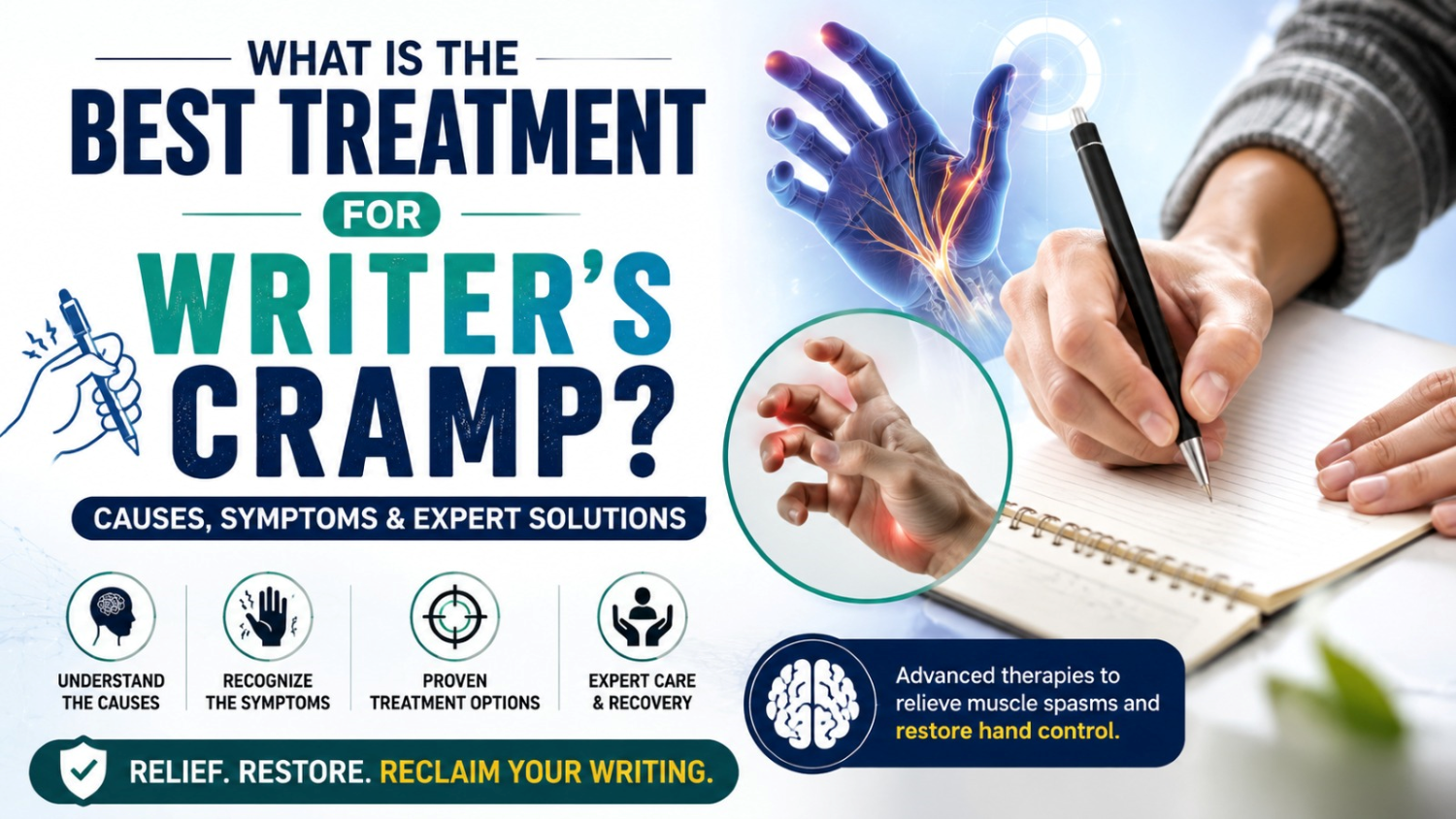
You decide to write a birthday card. Easy enough, isn’t it? But around the first line’s halfway point your hand begins dragging in a direction you did not ask it to. Your fingers stiffen. The way I hold the pen is off. Though you try changing, nothing works. Your hand normally feels perfectly fine, which is a weird thing. If that sounds familiar, you are not dreaming things. And no, it is not only “getting older” or “writing too much.”
You might be suffering with writer’s cramp, a genuine, known neurological disorder that does not get the attention it needs. People usually wait months or even years before asking for help since they think it would just go away on its own. Not often does it. The best therapy for writers’ cramps is available; the earlier you search for it the higher your odds of returning to writing free of the daily fight with your own hand.
What Is the Best Treatment for Writer’s Cramp?
Honestly? There is no one solution. One person’s ideal could not be appropriate for another. Almost always a customized combination and determining that combination, a neurologist can walk you through, is the ideal treatment for writer’s cramp.
Every primary choice is shown here:
Botulinum Toxin (Botox) Injections
One of the most potent treatments now available for writer’s cramp is the same chemical used in little, precisely targeted doses that you may have heard of for cosmetic reasons.
It blocks the nerve impulses to the particular muscles that are over-contracting only for a little time. The muscles relax, the erratic movements stop, and many people discover they can write far more easily in the few weeks following an injection.
The shots target the problem hand or forearm muscles. Repeat treatments are required as effects usually run three to four months.
It’s not a long-term cure, and the proper muscles must be aimed exactly; hence, it’s important that a neurologist knowledgeable in movement disorders executes this. Botox and physical treatment together provide the best outcomes for mild to severe instances.
Medications
Oral medications are not usually the first choice, but they have a role especially when injections are not accessible or suitable for a particular patient.
Anticholinergic medications like trihexyphenidyl are the most commonly tried. Muscle relaxants and low-dose benzodiazepines like clonazepam may also help in some cases, particularly to take the edge off during flare-ups.
Physiotherapy
Physiotherapy for writer’s cramp is not simply about stretching your fingers. The real goal is sensorimotor retraining essentially teaching the brain to send the right signals again through repetitive, guided movement practice.
A trained physiotherapist can work through:
- Exercises to rebuild individual finger control
- Stretching and strengthening for the hand, wrist, and forearm
- Immobilisation techniques where uninvolved fingers are splinted to encourage the affected ones to work differently
- Coordination drills that gradually rebuild smooth, controlled writing movements
This takes time and commitment. It is not a quick fix. But for people who start early and stick with it, physiotherapy can produce genuine, lasting improvement sometimes even without needing injections.
Occupational Therapy
While physiotherapy focuses on retraining movement patterns, occupational therapy focuses on helping you actually live and work with writer’s cramp as treatment progresses.
An occupational therapist can suggest:
- Grip modifications and alternative writing techniques
- Adaptive pens weighted, angled, or with thicker handles that require less clamping force
- Desk and posture adjustments that reduce overall strain
- Practical strategies for the workplace, especially if writing is a core part of your job
Even something as small as switching to a different pen can make a noticeable difference to daily comfort.
rTMS (Repetitive Transcranial Magnetic Stimulation)
Among the more interesting recently available choices for authors is rTMS. In this case, the motor and sensory areas of the brain that control hand movement, it works by sending mild magnetic pulses to particular areas of the brain. Normalising the aberrant brain activity that causes focal dystonia hence tackling the condition at its actual source rather than only treating the muscles is the goal.
It does not call for any implant, surgery, or anaesthesia. Most people tolerate it pretty well.
Though early results are positive for chosen individuals, the study is still under progress. It is usually thought about when more tried-and-true methods of treatment have not produced enough relief. A neurologist must determine whether it is suitable for a specific person; it is not a typical first-line choice for everyone.
What Is Writer’s Cramp?
This is the easiest approach to consider: The issue is not your hand. Your brain is One kind of focal dystonia, a disorder in which the brain sends the incorrect signals to the muscles utilized during writing. The writer’s cramp is These incorrect signals cause voluntary muscle contractions, strange postures, and lack of control especially when you are attempting to write. The important word here is “exactly.” Most other uses of your hand are quite normal; it may shake hands, eat with a fork, or keyboard.
But pick up a pen to write, and something goes wrong almost immediately. This is what makes writer’s cramp different from simple muscle fatigue. When your hand gets tired after a long day of writing, a completely normal rest fixes it. Writer’s cramp does not go away with rest. It comes back every time you try to write, because the root cause is not in the muscles at all. It is in how the brain is coordinating that very specific movement.
Types of Writer’s Cramp and Why It Matters
Not all writer’s cramps are the same. There are two forms, and knowing which one you have changes the treatment approach.
Simple writer’s cramp is the more common type. The problem shows up only when writing. Everything else, typing, buttoning your shirt, eating feels completely normal. You would never know anything was wrong until you picked up a pen.
A dystonic writer’s cramp is less common but more disruptive. Here, the involuntary muscle movements start affecting other hand activities too. You might notice it when using scissors, playing a musical instrument, or even just holding a glass. It is a sign that the condition has progressed, and it typically needs more intensive treatment.
What Does Writer’s Cramp Actually Feel Like?
People describe it in all sorts of ways “my hand fights me,” “it feels like something is pulling my fingers,” “my writing just falls apart halfway through a sentence.” The experience varies, but common signs include:
- Fingers stiffening or curling up while writing, even though you are not asking them to.
- A grip that feels off too tight, too awkward, too forced.
- Cramping or tightening in the hand, wrist, or forearm that comes on quickly.
- A slight tremor that only appears during writing.
- Handwriting that has noticeably got worse over time.
- Pain or fatigue after just a short period of writing
- The strange sense that you have “forgotten” how to hold a pen properly.
One thing to watch for: in the early stages, these symptoms usually only happen during writing. If you start noticing them during other tasks too, that is the point to seek help urgently rather than waiting.
What Causes Writer’s Cramp?
This is the question most people ask first, and the honest answer is: it is complicated, and there is usually no single cause.
- Years of repetitive writing can play a role. People who write for hours every day, doctors filling forms, students studying for exams, teachers marking work are at higher risk. Over time, the brain pathways for handwriting can become over-tuned in ways that backfire.
- The brain’s movement control system is at the heart of it. An area called the basal ganglia, which helps coordinate smooth, automatic movement, functions differently in people with dystonia. Think of it like a GPS that keeps giving wrong directions despite the road being perfectly fine.
- Family history occasionally plays a part. Most cases appear without any family pattern, but in a small number of patients, genetics seems to be involved.
- Stress does not cause it, but it can definitely make things worse on difficult days. This is worth knowing because many people with writer’s cramp quietly wonder if it is “all in their head.” It is not. It is a physical, neurological condition. Stress is just a trigger, not the source.
One more thing worth saying: writer’s cramp has nothing to do with weakness, carelessness, or poor posture. You did not bring this on yourself.
How Is Writer’s Cramp Diagnosed?
A neurologist is the person that fits here. Mostly by clinical evaluation your doctor will talk to you, observe your writing, and check on your hand and arm movements a writer’s cramp is identified.
A regular evaluation consists in:
- A thorough history: beginning starting, how has it evolved, what makes it better or bad questions on your daily writing practices and job.
- Seeing you really write this usually provides the most information from the evaluation.
- A neurological exam to assess muscle tone, coordination, and reflexes Eliminating conditions that might seem same Essential tremor, Parkinson’s disease, carpal tunnel syndrome.
An EMG (electromyography) could sometimes be used to find muscle activity patterns. Though a neurologist might ask for an MRI to rule out other reasons, brain imaging is often not required for a writer’s cramp.
Why Getting Help Early Actually Matters
Writer’s cramp does not tend to stay mild if left alone. What starts as occasional cramping while signing your name can quietly worsen over months until it affects most writing activities. In dystonic writer’s cramp, it can extend to other tasks as well.
Early treatment helps:
- Keep abnormal movement patterns from becoming deeply fixed in the brain.
- Preserve your handwriting ability for work, study, and everyday life.
- Prevent the compensatory habits people develop like hunching over the page or using an extreme wrist angle which cause their own problems over time.
- Keep more treatment options on the table before symptoms become severe.
If you have been noticing something is off with your hand during writing, this is worth taking seriously sooner rather than later.
Writer’s Cramp Treatment at Nirvan Hospital
Treated correctly, a writer’s cramp needs more than only a prescription and a leaflet. Your actual life, your work, your symptoms, how long you’ve had this, and what has or has not worked before all define a team that pays attention, assesses properly, and develops a plan around your situation. The neurology staff at Nirvan Hospital is knowledgeable about movement problems including focal hand dystonia. Patients have a comprehensive evaluation, not a rushed appointment, to determine which kind of writer’s cramp is present and what mix of therapies makes most sense for that person. Alongside neurological care, physiotherapy and rehabilitation are offered, which is important as treating writer’s cramp effectively practically always calls for coordinated efforts. And all the time, the patient’s needs, what is practical, and what will really enable them to write more easily remain front and center.
Final Thoughts
Writer’s cramp has a really irritating quality. It’s not dramatical; it doesn’t show up on a blood test; most individuals can’t see anything wrong from the outside. But the people living with it know just how much it influences their everyday life, their employment, their freedom.
There isn’t one universal answer for writer’s cramp. For your particular circumstances, symptoms, how long you have had them, daily needs, and how your body reacts to treatment, this is the correct mix of methods. Each of these botulinum toxins, physical therapy, occupational therapy, medicines, and alternatives including rTMS contributes significantly to the overall picture. Consider this your encouragement if you have been delaying getting treatment. The sooner you get a correct assessment, the better your chances of handling this well and the more choices you have. The neurology department at Nirvan Hospital will assist you to grasp what is happening and create a strategy that suits your life, not simply a general one.
Frequently Asked Questions (FAQs)
What is the best treatment for writer’s cramp?
Most people thrive on a mix instead of only one kind of therapy. For mild to severe situations, botulinum toxin injections are among the most successful and should be complemented with physical therapy. For more minor symptoms, occupational therapy and lifestyle adjustments may be a good beginning point. A neurologist is in the best position to suggest what is most appropriate for your particular case.
Is writer’s cramp permanent?
It’s a chronic illness, so it doesn’t just go away by itself. But also not quite correct is permanent in terms of consequences. The appropriate care helps a lot of people to get great results; some even handle it so well that it hardly interferes with daily life. Early intervention always produces superior outcomes than waiting. Usually necessary to keep development are consistent therapy and follow-up.
Can writer’s cramp be cured naturally?
There is no known natural treatment. Having said that, physical-based motor rehabilitation, ergonomic adjustments, and stress management truly help to improve alongside medical care. See them as vital additions to a therapy plan rather than substitutes for one. A neurologist-guided strategy is critical for moderate or severe symptoms.
Is Botox effective for writer’s cramp?
Yes, one of the strongest-supported treatments now available is botulinum toxin. Usually giving significant relief for three to four months per injection cycle, it calms the overactive muscles producing the issue. Combining Botox with physical therapy which concurrently aids the brain relearn right movement patterns usually produces the greatest outcomes.
Is writer’s cramp a neurological disorder?
Yes. It is classified as focal dystonia, a neurological movement disorder caused by abnormal signalling between specific brain areas and the muscles used in writing. It is not a muscle disease, not a psychological condition, and not simply the result of overusing your hand. Proper neurological assessment is the right first step.
Comments are closed