Subtotal ₹0.00

 Self Assessment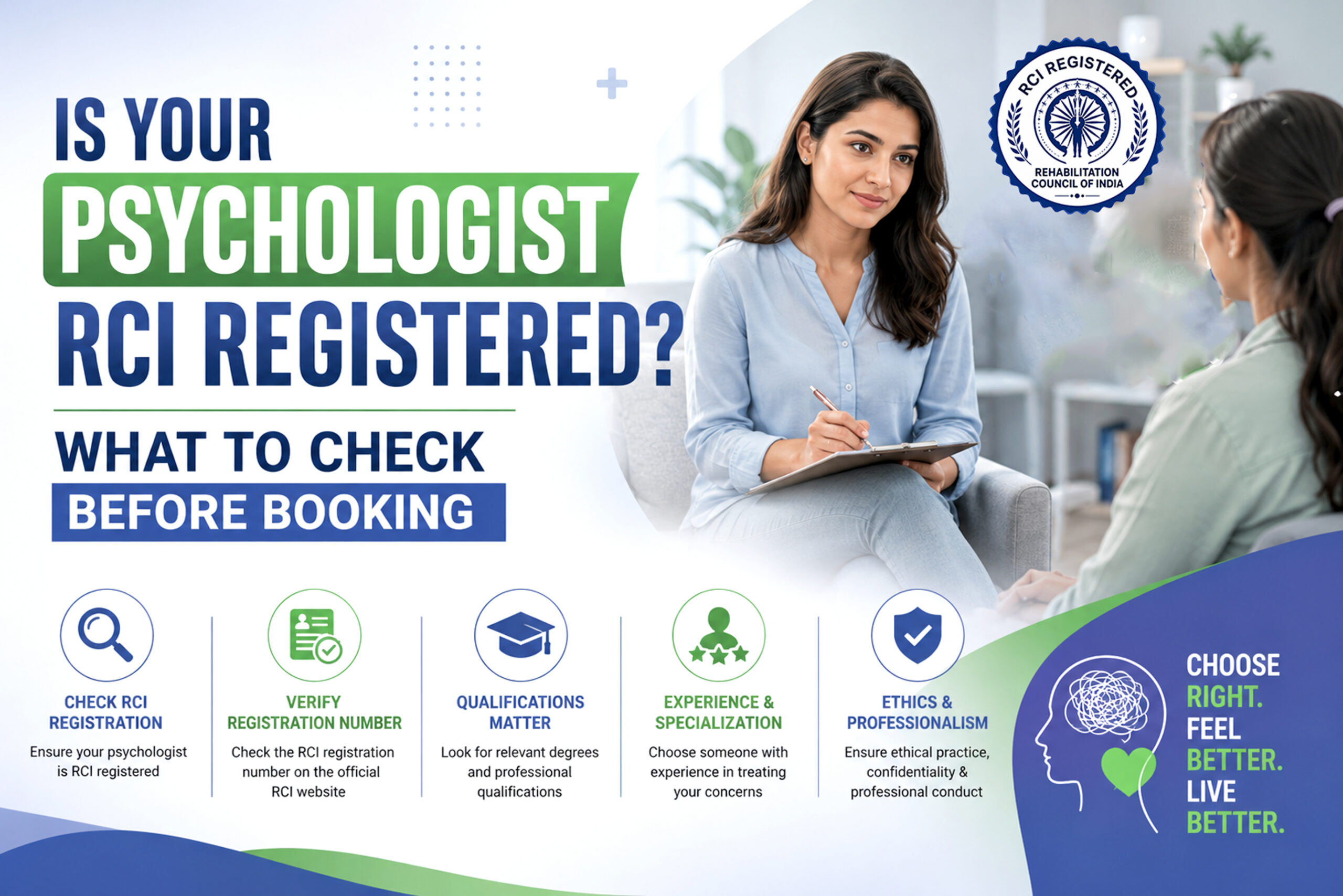
More individuals now are looking for therapy for issues such as stress, anxiety, burnout, grief, and relationship problems-a good change in perspective on mental health. But it’s as important to pick a qualified expert given the rising need of psychological help. Many people don’t know that terms like psychologist can be used in general, which makes it challenging to interpret a practitioner’s qualifications or credentials. One crucial element to verify is whether a clinical psychologist is RCI registered, as this shows acknowledged training and professional standards. This piece discusses the significance of RCI registration and what to watch out for before making your first appointment.
Why Does RCI Registration Actually Matter?
It’s easy to treat this as a bureaucratic checkbox, but it’s really not. A few reasons it’s worth caring about:
- Recognized education and training – registration confirms the person completed accredited coursework, not just a short course or certificate program
- Ethical responsibilities – registered professionals are bound by a code of conduct, which matters when you’re sharing personal, sensitive information
- Accountability – there’s an actual body to report concerns to, which isn’t the case with unregulated practitioners
- Patient safety – particularly important when it comes to assessment and diagnosis, where mistakes have real consequences
- Standardized practice – a level of consistency across professionals, instead of every practitioner working entirely on their own interpretation of best practice
None of this means unregistered people can’t be helpful in some capacity. But when it comes to clinical work actual diagnosis, structured assessment, formal treatment planning registration is the difference between informed care and guesswork.
7 Things to Check Before Booking a Psychologist
1. Verify RCI Registration
This is the foundational check. If someone is offering clinical services, ask directly whether they’re RCI registered and don’t be shy about it. It’s a completely normal question and any legitimate professional will answer it without hesitation.
2. Check Educational Qualifications
Look for accredited degrees from respectable universities. A real clinical history usually consists of a well-defined educational path free of ambiguous mentions of training or certification without details.
3. Understand Their Area of Expertise
Mental health is broad. Someone skilled in trauma work might not be the right fit for child psychology, and someone experienced with anxiety might not specialize in couples counselling. Matching expertise to your actual concern matters more than people often realize.
4. Look for Experience With Similar Concerns
Although credentials help you in the doorway, relevant practical experience usually determines how thoroughly someone truly grasps your particular situation. It’s worth wondering, just, whether they have previously handled issues just like yours.
5. Confidentiality and Ethical Practice
Mental health work involves sharing things that are genuinely personal. Confidentiality isn’t a nice-to-have, it’s foundational. A professional environment should make this clear without you having to ask twice.
6. Treatment Approach
Research-backed, evidence-based treatment modalities, rather than ambiguous or unproven ones-usually provide more consistent results. A patient-centered strategy also counts rather a little here as treatment is molded around your particular needs rather than a one-size-fits-all model.
7. Reviews, Reputation, and Hospital Support
Reviews can offer some useful context, but they shouldn’t be the deciding factor on their own; they’re subjective, and they don’t tell you anything about actual qualifications. A hospital or clinical setting that backs the professional, with proper credentialing and oversight, generally offers more reliable reassurance than reviews alone.
Mental Health Support at Nirvan Hospital
It’s a crucial inquiry to consider before scheduling an appointment if you’re not sure if your psychologist is RCI registered. Clinical psychologists at Nirvan Hospital are RCI registered, which means they have the degree, supervised training, and professional credentials needed to do psychological evaluations and give evidence-based mental health treatment within their range of practice. Along with qualified knowledge, the hospital stresses ethical conduct, secret consultations and customized treatment programs fit to every person’s demands instead of a one-size fits all strategy. Whether you are looking for support for stress, anxiety, sadness or other emotional problems, Nirvan Hospital provides a welcoming and patient-centered environment where you can feel certain that trained mental health specialists are guiding your treatment.
Who Actually Needs to Be RCI Registered?
This is where things get a little confusing for most people, so let’s clear it up simply. Clinical psychologists and rehabilitation psychologists the professionals doing formal assessments, diagnosis and structured clinical treatment are required to be RCI registered. If someone is offering psychological assessment or clinical psychological services, RCI registration isn’t optional; it’s a legal requirement.
That said, not every mental health professional falls under this specific requirement. Counsellors, for instance, often operate under different qualifications and aren’t always required to hold RCI registration, depending on the nature of their work. If what you need is general support through a difficult period, a psychologist or counsellor might be a perfectly reasonable starting point. If you’re dealing with something that needs formal diagnosis or structured clinical treatment, a clinical psychologist, one who’s RCI registered is who you actually want to be booking with.
Final Thoughts
Choosing a psychologist requires more than just RCI registration; it’s a significant, verifiable sign that someone’s credentials have genuinely been checked against a recognized standard instead of just accepted at face value.
It helps to guarantee the care you get really fits what you’re facing when mixed with the correct knowledge, pertinent experience and a patient-centered, ethical approach. If you’re thinking about getting professional mental health help, places like Nirvan Hospital have qualified, well-credentialed experts in a structured, supportive environment that can make that first step much less intimidating.
Frequently Asked Questions
Why should I check if a psychologist is RCI registered?
Checking registration serves to confirm the professional’s actual, confirmed clinical training rather than unconfirmed or informal qualifications. For official evaluation, diagnosis, and clinical treatment-where correct credentials directly impact the caliber and safety of the care you get-this is especially important.
Can I verify an RCI registration online?
Yes. The official RCI website maintains a searchable professional register where you can look up registration numbers and confirm their validity. It usually takes just a few minutes and is a reasonable step before committing to sessions with any clinical psychologist.
Is every psychologist required to be RCI registered?
Not necessarily. Clinical and rehabilitation psychologists offering formal assessment or clinical treatment are legally required to be RCI registered. Some other mental health professionals, like certain counsellors, may operate under different qualifications and aren’t
Can an RCI-registered clinical psychologist diagnose mental health conditions?
Yes. One of the main differences between a clinical psychologist and a general psychologist or counsellor is that RCI registered clinical psychologists are educated and authorized to do psychological evaluations and give diagnoses as part of their clinical scope of practice.
Why does Nirvan Hospital emphasize qualified mental health professionals?
Because proper qualifications directly affect the quality and safety of care patients receive. Nirvan Hospital focuses on working with qualified, evidence-based mental health professionals to provide consultations and treatment plans that are appropriately suited to each individual’s specific needs.
Comments are closed