Subtotal ₹0.00

 Self Assessment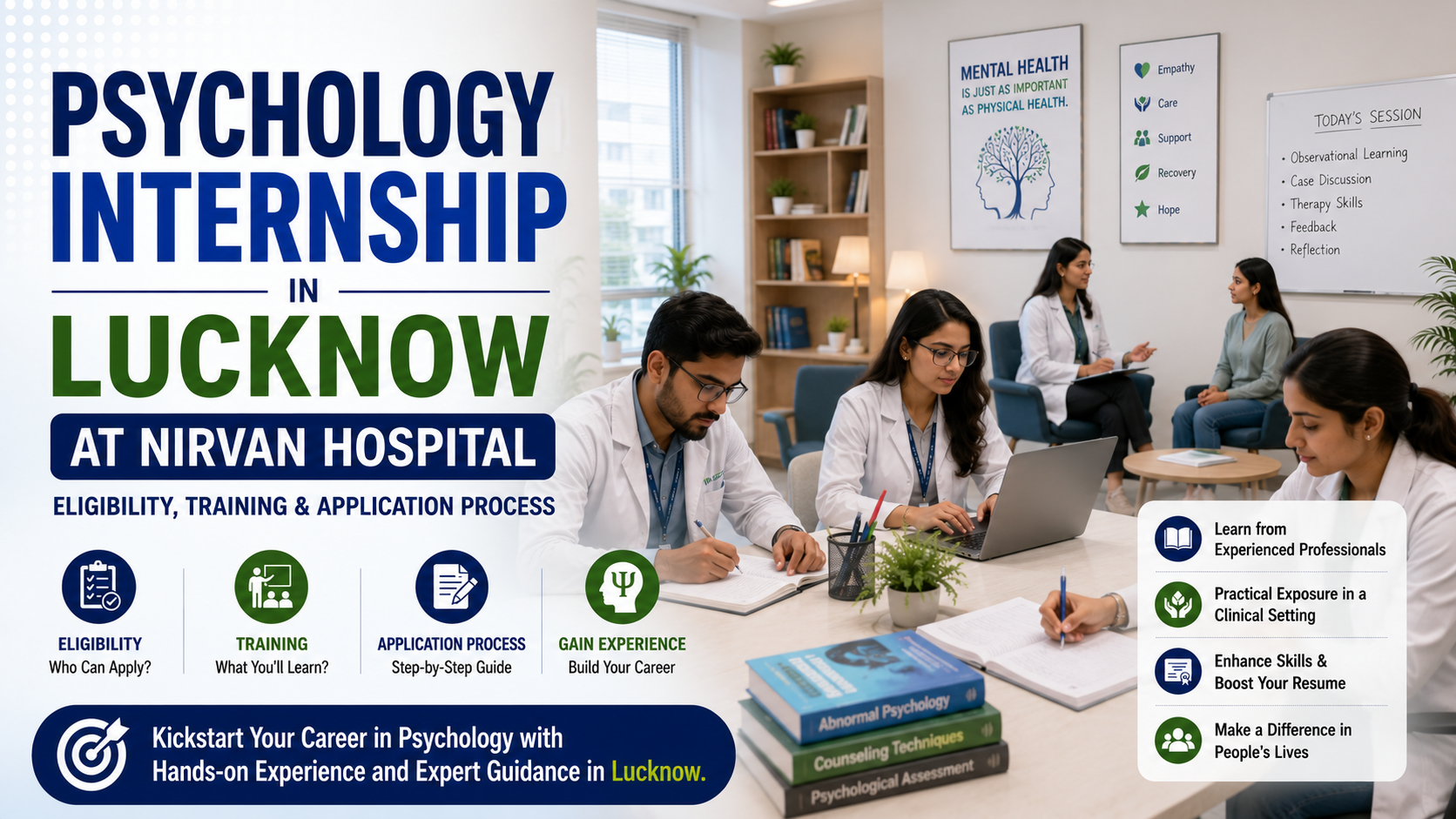
Mental health isn’t a niche topic anymore. More people are talking about therapy, more families are willing to seek help, and that shift has created real demand for trained psychology professionals, not just people with a degree, but people who actually know how to work with patients in a real clinical setting. That’s the gap an internship fills.
For students based in Lucknow, finding that kind of practical exposure locally makes a real difference, no relocating, no juggling a new city while trying to learn a new skill set. Nirvan Hospital is one option where psychology students can get supervised clinical experience, working alongside a mental healthcare team and observing how care actually gets delivered, day to day, to real patients.
Why Consider an Internship at Nirvan Hospital?
A hospital setting exposes interns to a wider range of mental health conditions than most academic placements allow for. Instead of studying a handful of case studies, interns get to see under supervision how different conditions actually present in real patients, and how treatment approaches shift accordingly.
Working in a multidisciplinary environment is part of what makes this useful. Interns at Nirvan Hospital are exposed to how psychiatrists, psychologists, and other specialists coordinate care together rather than working in isolation. Depending on the placement, there may be opportunities to observe assessments, sit in on counselling sessions, watch how therapy plans are developed, or see rehabilitation practices in action always under proper supervision, and always within the hospital’s ethical and confidentiality standards.
It’s worth being upfront here: an internship isn’t a guarantee of a particular outcome or a fast-tracked career. What it offers is structured, supervised exposure to real clinical work in a professional setting which, for most students, is exactly what’s missing after years of classroom-only learning.
Eligibility for Psychology Internship
Eligibility requirements can vary depending on the specific internship opening and university requirements, but generally, students from the following backgrounds are considered:
- BA Psychology
- BSc Psychology
- MA Psychology
- MSc Psychology
- Applied Psychology
- Clinical Psychology students
- Final-year students, where their university or course structure allows it
- Fresh graduates looking for clinical exposure before further studies or employment
Beyond academic background, most internship placements also look for basic communication skills, a professional attitude, and a genuine interest in mental healthcare, not just a credential to add to a resume.
Skills That Help Interns Succeed
Some skills matter more in a clinical setting than people initially expect:
- Active listening – picking up on what’s said and what isn’t
- Empathy – without it, clinical work becomes mechanical fairly quickly
- Observation – noticing patterns in behaviour, mood, and communication
- Communication – both with patients and with the broader care team
- Confidentiality – non-negotiable in any clinical setting
- Documentation – accurate notes matter more than most students expect going in
- Teamwork – mental healthcare rarely happens in isolation
- Professional ethics – knowing where boundaries exist and why
- Time management – juggling observation, documentation, and learning simultaneously
- Emotional resilience – some cases are heavy, and interns need to manage that without becoming detached
- Willingness to learn – probably the most underrated one on this list
What Training Can Interns Expect?
Clinical Observation
Often the first actual introduction students have outside of a textbook to clinical work is seeing how psychologists and psychiatrists interact with patients, answer questions, and build connections.
Psychological Assessments
Observing how assessments are conducted and how results feed into a broader understanding of a patient’s condition.
Case Discussions
Sitting in on team discussions about specific cases, which helps interns understand how clinical decisions actually get made.
Counselling Process
Getting a sense of how counselling sessions are structured, paced, and adapted depending on the patient.
Behavioural Observations
Learning to notice and record behavioural patterns relevant to diagnosis and treatment.
Report Writing and Documentation
Understanding how clinical notes, assessment reports, and case files are maintained accurately and professionally.
Rehabilitation Programs
Exposure to how rehabilitation is structured for patients recovering from various mental health conditions.
Psychoeducation
Observing how patients and families are educated about a condition and its management.
Exposure to Different Departments
Depending on the placement, interns may rotate through different areas of mental healthcare delivery within the hospital.
Patient Interaction Under Supervision
Any direct interaction with patients happens under close supervision, with clear ethical boundaries in place throughout.
What Will You Learn During the Internship?
By the end of a well-structured internship, students typically walk away with a much clearer understanding of psychological disorders not just from books, but from observing how they actually present in patients. Clinical interviewing and assessment techniques start to feel less theoretical. Therapy planning starts making more sense once you’ve seen it built in real time.
Communicating with patients and their families is its own skill entirely, and it’s one most students haven’t had to practice before an internship. The same goes for professional documentation getting comfortable writing clear, accurate clinical notes. And working alongside a multidisciplinary team teaches a kind of collaborative thinking that’s hard to replicate in a classroom. All of it adds up to something simple but valuable: more confidence going into whatever comes next in a psychology career.
Application Process for Psychology Internship at Nirvan Hospital
The process is fairly straightforward, though it naturally varies a bit depending on current openings:
- Check internship availability – confirm whether the hospital currently has open positions for psychology interns.
- Verify eligibility – make sure your academic background and year of study match the requirements.
- Prepare an updated resume – highlighting relevant coursework, any prior exposure, and relevant skills.
- Gather academic documents – degree certificates, mark sheets, and any required university documentation.
- Submit your application – through the appropriate channel specified by the hospital.
- Attend an interview, if applicable – some placements include a short conversation to understand a student’s background and interest.
- Complete documentation – including any consent or confidentiality agreements required before starting.
- Receive confirmation – of the internship dates, duration, and reporting details.
- Begin orientation and the internship itself – usually starting with an introduction to hospital protocols before clinical exposure begins.
Tips to Prepare Before Starting Your Internship
A little preparation goes a long way once the internship actually starts:
- Revisit core psychology fundamentals diagnostic categories, basic therapeutic approaches
- Read up on professional ethics, particularly around confidentiality
- Work on communication skills, especially active listening
- Maintain professionalism in dress, punctuality, and conduct
- Carry all necessary documents on day one
- Go in with a genuine willingness to learn rather than assumptions about how things work
- Take confidentiality seriously, even in casual conversations outside the clinical setting
- Ask thoughtful questions instead of staying silent out of hesitation
- Keep a learning journal it helps more than people expect when reviewing progress later
Career Opportunities After Completing a Psychology Internship
A psychology internship opens doors across a fairly wide range of settings, including:
- Hospitals
- Mental health centres
- Rehabilitation centres
- Schools
- NGOs working in mental health or community welfare
- Corporate wellness programs
- Research roles
- Higher education and further academic study
- Counselling centres
- Clinical psychology, with additional qualifications and licensure
Why Nirvan Hospital Can Be a Good Learning Environment
What tends to matter most for students choosing where to intern is the quality and structure of the learning experience, not just the name on the certificate. Nirvan Hospital offers genuine clinical exposure within a multidisciplinary team of experienced mental healthcare professionals, working with a patient-centred and ethical approach to care.
The learning structure tends to be organized rather than haphazard, giving interns a clearer sense of progression as they move through different aspects of clinical exposure. Combined with a generally supportive environment for students still finding their footing in clinical work, it’s the kind of setting where practical skills have room to actually develop without any unrealistic promises about what an internship alone can guarantee for a future career.
Final Thoughts
Usually the first true link between academic psychology and the job itself, an internship is not only a bullet point on a CV. Real patients, real paperwork, real multidisciplinary teams-none of that is derived from a textbook, regardless of the complexity of the curriculum.
The most important thing following an internship is building on it. One job is a beginning, not a destination, so it doesn’t make someone a finished doctor. Students in Lucknow seeking that beginning point could think about looking into a psychology internship at Nirvan Hospital. Should you seek practical, monitored exposure to mental healthcare, then. Early practical experience helps a psychology student to walk into whatever road-clinical practice, research, counselling or something else-confidently.
Frequently Asked Questions
Who can apply for a psychology internship at Nirvan Hospital?
Students currently pursuing or having completed a degree in psychology BA, BSc, MA, MSc, Applied Psychology or Clinical Psychology are typically eligible, depending on current openings and university requirements. Final-year students may also apply where their academic structure permits it. A genuine interest in clinical mental healthcare work matters as much as the degree itself.
How long does a psychology internship usually last?
The length of an internship will depend on the particular placement, academic needs and hospital availability when you apply. While some internships last a few weeks, some stretch a few months. Since the precise length isn’t fixed across every placement, it’s advisable to apply straight from the current internship information.
What documents are required for the application?
Most of the time, students will need an updated resume, academic credentials and transcripts, a university letter of recommendation or no-objection letter if needed and any identification documents asked for during the application process. Usually finished once the internship is verified, additional paperwork-confidentiality agreements.
Will interns get hands-on clinical exposure?
Interns are closely supervised in clinical environments, where they see assessments, therapy sessions and case discussions. Where it occurs, direct patient contact is under strict observation and constrained by the confidentiality and ethical rules of the hospital. The precise degree of exposure relies on the particular placement and a student’s development over the internship.
What skills can students develop during the internship?
Along with a better grasp of professional ethics and confidentiality, students often acquire active listening, empathy, observation, communication and paperwork abilities. Since clinical settings call for patience and attitude while dealing with actual cases, time management and emotional resilience also typically get better.
Comments are closed