
Subtotal ₹0.00
 Make Appointment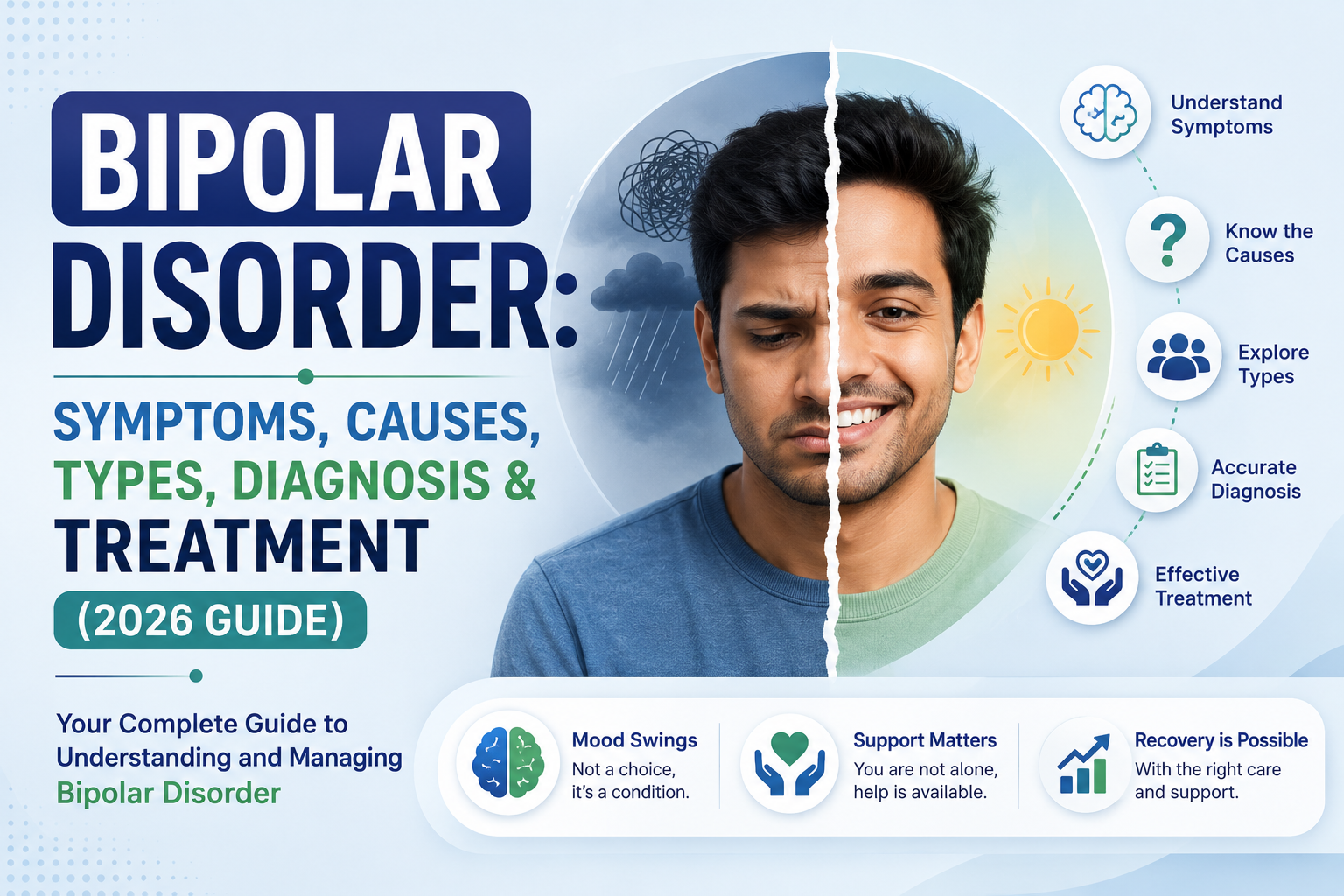
Bipolar disorder is far more serious than just having a few bad days or mood swings. Everyone has emotional ups and downs but bipolar disorder is a serious mental health condition that causes major changes in a person’s mood, energy, thinking and behavior. If left untreated, these changes can lead to problems with daily living, relationships and work. The condition is hard to diagnose as some people have times of manic excesses with abnormally high energy and impulsive behavior and other people have more time in depression. With bipolar disorder, early diagnosis and effective treatment are key.
So What Is Bipolar Disorder, Really?
At its core, bipolar disorder is a mood disorder where a person cycles through episodes of mania (or a milder version called hypomania) and depression. Not random sadness, not random excitement, actual episodes, lasting days to weeks, with a clear before-and-after. Doctors believe it comes down to how certain brain chemicals that control mood and energy are regulated. Something in that system doesn’t reset the way it’s supposed to, and the result is mood states that swing far past what circumstances would explain.
Here’s a simple way to separate it from ordinary mood swings: duration and disruption. Feeling great after good news, or low after a bad week that passes on its own. Bipolar episodes don’t resolve in a few days, and they tend to derail things like work, sleep, relationships and money in a way a normal mood never does.
What Bipolar Disorder Actually Looks Like?
Most individuals feel both at different periods as symptoms go in two opposite directions.
A manic phase sees energy shoot through the roof. There’s a restless enthusiasm that contradicts reality. Someone could believe they are unbreakable, amazing, like they have at last sorted out all. Sleep loses its importance; four hours seems plenty. Speech quickens; ideas come more quickly than they can be spoken aloud; and choices get made on impulse: a major buy, a quick trip, immediately quitting a job. Often people get irritable too, particularly if someone attempts to slow things down.
A depressive period is practically the exact opposite. A weight that won’t get better. Energy vanishes. Friends, pastimes, food stop feeling like anything at all, friends, food. The other direction now, either too much or hardly any, is how sleep goes haywire. Focus becomes difficult; even little choices are taxing; and sometimes there is a creeping sense of being useless or a burden. More extreme situations have this devolving into suicide ideation.
The last one should be said directly: suicidal ideas are a medical emergency, not something to wait out or handle alone. Should they appear, the best course of action is fast expert care at a mental health hospital, a crisis line, or an emergency room which is nearest.
The Different Types of Bipolar Disorder
Since not everyone who has bipolar disorder has the same experience, it is divided into a few types.
Bipolar I is the one most people envision at least one full manic episode, sometimes severe enough to warrant hospitalisation, usually accompanied with melancholy episodes somewhere along the course.
Bipolar II instead alternates between sadness and hypomania; a softer, less severe variant of the high phase skips the entire mania. This kind is mistaken for simple depression more often than people realize because the highs are not as extreme.
Cyclothymic disorder of the three common highs and lows never quite reaches full mania or significant depression but continuing for two years or more, cyclothymic disorder is the mildest.
Causes Of Bipolar Disorder
If you’re looking for one single cause, you won’t find bipolar disorder is almost always the result of several things stacking up together. Genetics plays a big part. Having a parent or sibling with bipolar disorder raises the odds noticeably, though it’s not a guarantee by any means. Brain chemistry matters too specifically how neurotransmitters that regulate mood are functioning, or not functioning properly.
Then there’s life itself: chronic stress, major trauma, and disrupted sleep can all act as triggers in someone who’s already predisposed. Substance use complicates things further, sometimes setting off an episode or making an existing one worse. Hormonal shifts are also thought to play a role for some people. None of these alone fully explains it. It’s usually a mix.
Things That Raise the Risk
A few elements that usually show up more often in people who later develop bipolar disorder include a family history of mood disorders, significant life changes, long-term chronic stress, continuous alcohol or drug misuse and certain underlying medical conditions. One of these just means it’s worth paying more attention if symptoms start showing up; it does not indicate someone will certainly develop the disease.
Getting a Diagnosis
No blood test or scan, on its own, validates bipolar disorder. One obtains a diagnosis by piecing together many things.
Usually, a psychiatrist will first have a thorough discussion on daily events, then go into medical history, past disorders, drugs, anything pertinent in the family. From there, they will work to show the mood history itself: when episodes happened, how long they were, and how severe they became. A physical exam and some screening surveys sometimes follow, partly to rule out alternative disorders with similar symptoms, such thyroid issues or the results of substance abuse.
This attention to detail is more important than it first appears. Many times, bipolar II is mistaken for simple depression as the manic component is so much quieter. Get it incorrect and the treatment plan ends up centered on the incorrect issue.
How It’s Treated?
There isn’t a single fix here: treatment usually combines a few approaches working together.
Medication tends to be the backbone. Mood stabilizers help keep the swings in check. Antipsychotics are often brought in for managing manic or mixed episodes. Antidepressants get used too, but carefully, and almost always alongside a mood stabilizer, since on their own they can sometimes nudge someone into mania. Anti-anxiety medication sometimes joins the mix as well, depending on what else is going on.
Therapy does a lot of heavy lifting alongside medication. Cognitive Behavioural Therapy helps untangle the thought patterns that feed into episodes. Family therapy brings loved ones into the process so they understand what’s happening and how to help. Psychoeducation basically learning about the condition itself, its triggers, its early warning signs gives people more control over what’s coming. And Interpersonal and Social Rhythm Therapy focuses specifically on stabilizing daily routines, especially sleep, which turns out to be a surprisingly powerful lever for mood.
Lifestyle rounds things out. A consistent sleep schedule, regular movement, decent food, some kind of stress outlet, staying away from alcohol and recreational drugs and maybe most underrated actually showing up for follow-up appointments even when things feel fine.
Bipolar Disorder Treatment at Nirvan Hospital
For a chronic illness like bipolar disorder, not all mental health treatment is created equal; over years that difference accumulates. Worth looking for are psychiatrists that really focus on mood disorders rather than general practice, clinical psychologists for therapy and correct assessment, genuine counselling services instead of a checkbox, emergency psychiatric care for when things get urgent, contemporary diagnostic tools, and maybe most crucially, treatment regimens tailored for the person instead of a standard template. Along with a method for long-term follow-up instead of a one-and-done appointment, a confidential, judgment-free atmosphere also helps.
With a multidisciplinary staff providing evidence-based care, individualized treatment planning, counseling, medication management, and ongoing follow-up in a nurturing environment, Nirvan Hospital is regarded as one of the reliable choices for bipolar disorder treatment. It’s the kind of continuous arrangement that usually matters more than just one meeting.
Final Thoughts
Though difficult, controlling bipolar disorder is not impossible. Knowing what the symptoms actually look like, knowing the several types, and knowing what treatment actually entails will help one to handle this disease as a patient and as a caregiver differently.
The early diagnosis, correct treatment, and continuous support taken together are what change everything. If symptoms are impacting daily living, it’s wise to be checked instead of waiting to see if things would naturally improve. Hospitals like Nirvan offer the thorough, continuous care that helps patients and their families manage diagnosis, treatment and long-term rehabilitation.
Frequently Asked Questions
What are the first signs of Bipolar Disorder?
It usually begins with little changes in sleep, an unexpected burst of energy or motivation that doesn’t quite make sense, irritability that appears out of proportion, or times of low mood and disinterest in things that used to count. These usually appear when they start to influence employment or relationships.
Can Bipolar Disorder be cured permanently?
Not in the sense of a one-time fix; no. It’s a chronic ailment. With regular care, medication, therapy, and good habits, though, most individuals achieve extended real stability, similar to how other chronic diseases are handled throughout a lifetime instead of cured fully.
What is the best treatment for Bipolar Disorder?
To be honest, it varies per individual; there is no one universal response. Most successful strategies combine mood-stabilizing medication with therapy like CBT and daily behaviors including regular sleep. A psychiatrist molds this depending on a person’s symptoms and how they change over time.
How long does Bipolar Disorder treatment take?
Usually continuing instead of a set path, the aim is long-term care instead of a finish line. Though stabilization may take a few weeks to months, maintenance care and routine follow-up normally last far longer.
What happens if Bipolar Disorder is left untreated?
Over time, without therapy, episodes sometimes become more severe and more frequent. It can greatly impact relationships, jobs and physical health; severe depressive episodes come with actual risk including suicide ideation. Early therapy greatly lowers that risk.
Comments are closed